Case File: Conversations · available now
Talk to someone who talks back.
An officer knocks on a door. The person who answers is tired, or friendly, or has had bad experiences with police, or is nineteen and has been through the system. They answer, they ask their own questions, they ramble, they cut in, they react to how they're treated. When it's over, the officer reads a debrief that quotes their own words.
How a run works
Knock, talk, read the debrief
Ten minutes, start to finish. Then do it again, and get a different person at the same door.
1. The call
A car broken into overnight on Cedar Lane. The officer reads the call sheet, picks a door, and knocks.
2. The person
Who answers, and what mood they're in, is drawn fresh each run: the temperament, how much time they've had with the system, how hot they come at police, how fast they talk, even the face.
3. The conversation
They answer back and remember what was said. They ask questions of their own ("Is this happening all over, or just our street?"). They ramble, they cut in mid-question, a radio call interrupts. What they know comes out when they're comfortable enough to say it.
4. When it goes wrong
Pull rank, threaten, talk down to them or call them a name, and they react the way a person would. Some shut down. Some close the door. The debrief says so.
5. The debrief
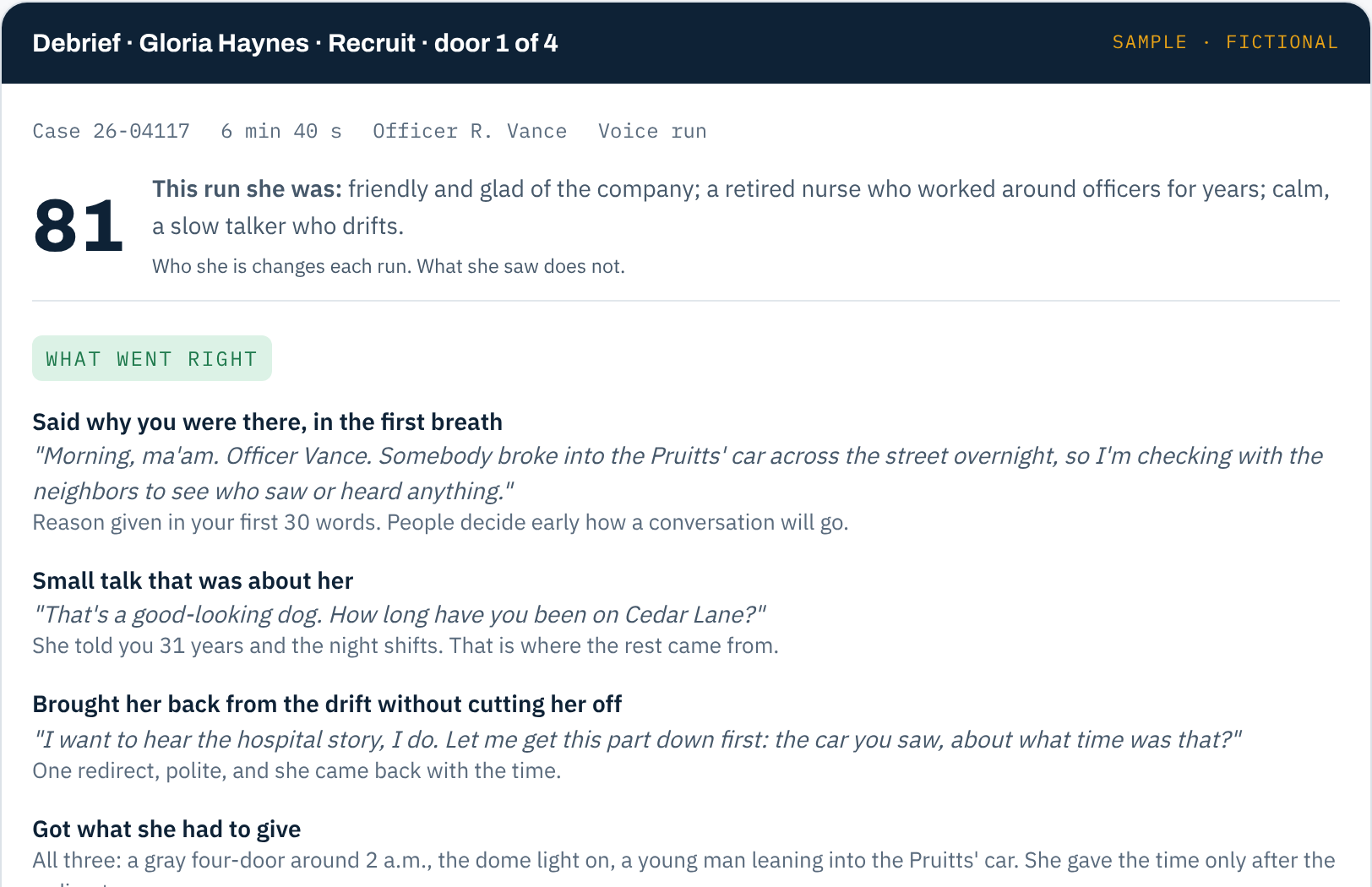
What went right first, with the officer's own line as evidence. Then at most two things to try next time, written as something to say. Then the twelve items, the door's own items, and the job: said why you were there, asked about the case, got what they had to give, closed properly.
6. The record
Every run keeps its transcript, its debrief and its audio for the department. The coordinator sees each officer over time.
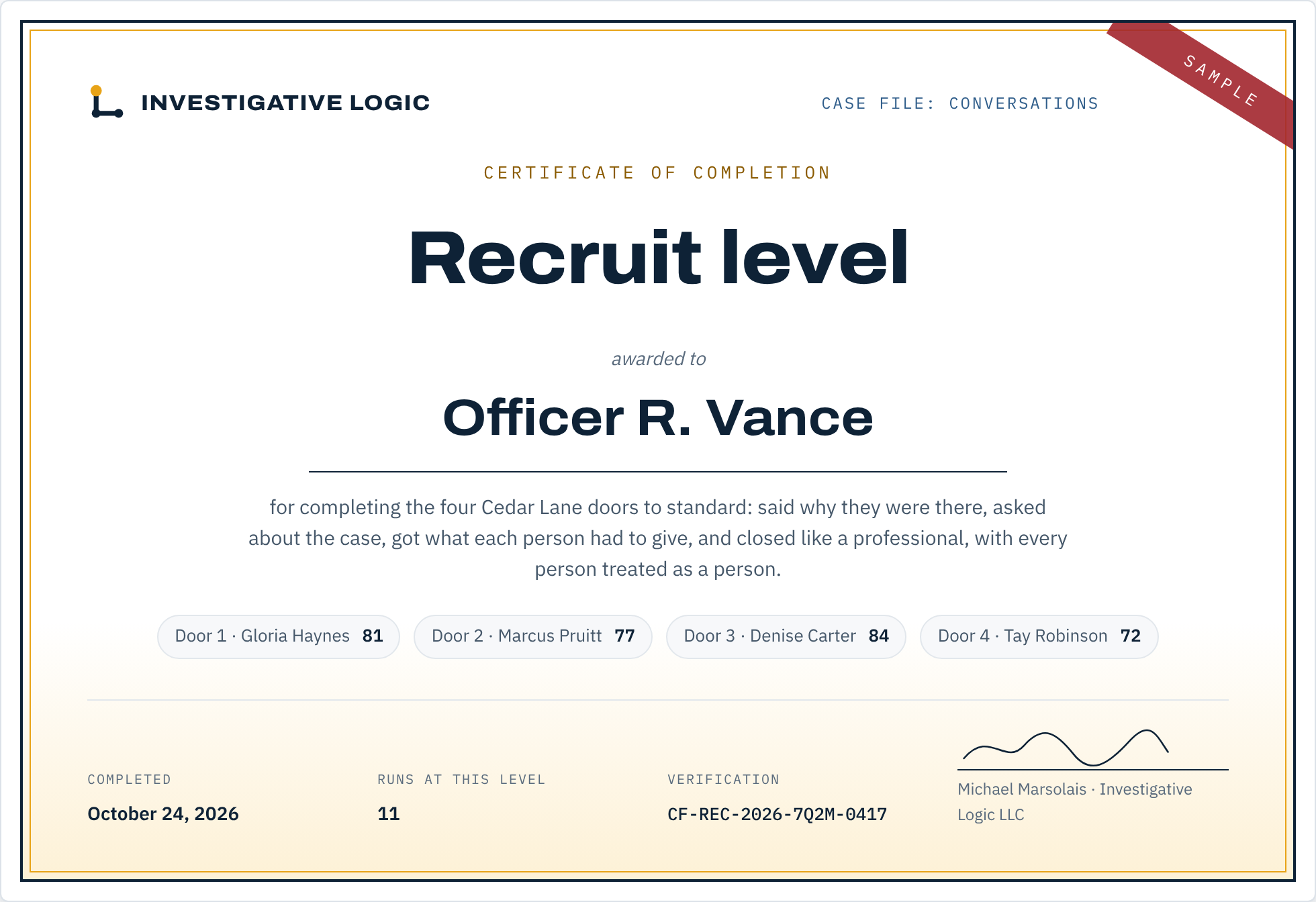
Recruit level
Four doors on Cedar Lane, then a victim at a scene
Each person is written as a full sheet: who they are, what they saw, what they'll say and when, how they come at police. The officer never sees the sheet. The debrief grades against it.
Gloria Haynes
58, retired nurse, widowed. Friendly, lonely, slow to get to the point. Saw something at midnight and will say so, once she's comfortable.
Marcus Bell
34, works nights. You woke him up. Not hostile, just tired and short, with about forty seconds of patience for an officer who doesn't say why he's there.
Denise Carter
41. Two bad experiences with police she hasn't forgotten. Tests the officer with a dig and a silence before she decides anything.
Tay Reeves
19, up all night, been through the system. Asks whether he's being detained. Curses when he's hot. Cools if the officer answers straight and stays level.
Kevin Moody
29, robbed at gunpoint an hour ago, embarrassed about why he was there. The first interview at the scene, graded against the seventeen steps a detective takes, and against what he holds back when his girlfriend is in earshot.
More doors, more cases
Field Training, Patrol, Investigator, Detective and Senior Detective levels, each with its own people and cases. Released to every account as they're built.
The debrief
Graded on the job, in the officer's own words
Every item is met, partly met, or missed, with the officer's exact line as evidence. The score grades the job first: did you say why you were there, ask about the case, get what the person had to give, and close like a professional. Manners count; they just don't carry a run that never got to the case.
- The approach: not robotic
- Small talk and general questions
- Shared a little of yourself
- Not too many closed questions
- Interrupting: when and how
- Not just after the facts
- A roadmap, few restarts
- Tone: not dismissive or condescending
- Pace
- The professional close
- Handled their questions
- Kept it level under challenge
A sample debrief from a fictional run. The real one is longer and names every item.
See it
A run, a debrief, a certificate
Why this skill
What the body-camera research says
The conversation is decided early, rapport is rare in practice, and the person across the table mirrors the officer. Every number here comes from a published study of recorded police encounters.
Using only the officer's first 45 words, about 27 seconds, a model predicted whether a traffic stop would end in a search, handcuffs or an arrest. The two markers: opening with an order, and not saying why. Rho, Harrington, Zhong, Pryzant, Camp, Jurafsky & Eberhardt (2023), PNAS 120(23); 577 recorded stops.
Of 161 recorded suspect interviews, three in a hundred opened with any rapport-building. Most interrogators said they used it; a quarter of the people interviewed said they experienced it. High-Value Detainee Interrogation Group (2016), Interrogation: A Review of the Science, FBI.
In 418 recorded suspect interviews, "even minimal expression of maladaptive interpersonal interrogator behavior increased maladaptive interviewee behavior," and less information came out. Alison, Alison, Noone, Elntib & Christiansen (2013), Psychology, Public Policy, and Law 19(4); UK.
In 981 recorded stops, people mostly gave short answers and pushed back with questions, not speeches: "For what?" "If I say no, am I in trouble?" The people in Case File are written from that record. Prabhakaran, Griffiths, Su, Verma, Morgan, Eberhardt & Jurafsky (2018), Transactions of the ACL 6.
The studies measured escalation and information yield. We don't claim they measured officer injuries.
Voice trial, from the website
Same people, same engine, same debrief, no picture. Use Chrome. Your agency email creates the account; a .gov or .us address is approved on the spot. Pricing →
Department plans, with video faces
The person on screen, lip-synced, drawn from a pool of faces per character. Pooled hours for the whole department, a coordinator's view, academy class blocks, and the department's own forms loaded into Investigations when it ships. Contact us →